
TheLivingCost.com is a popular tool for comparing living expenses across countries, but it has gaps — limited city-level detail, no salary calculations, minimal interactive features, and, at the time of this update (August 2026), recurring availability problems: the site has been intermittently unreachable. If you need more granular data or want to factor in taxes and net pay, several alternatives fill those gaps. This guide compares six tools side by side, covering what each does well, where it falls short, and who it works best for.
Table of Contents
ShouldIMove
At a Glance
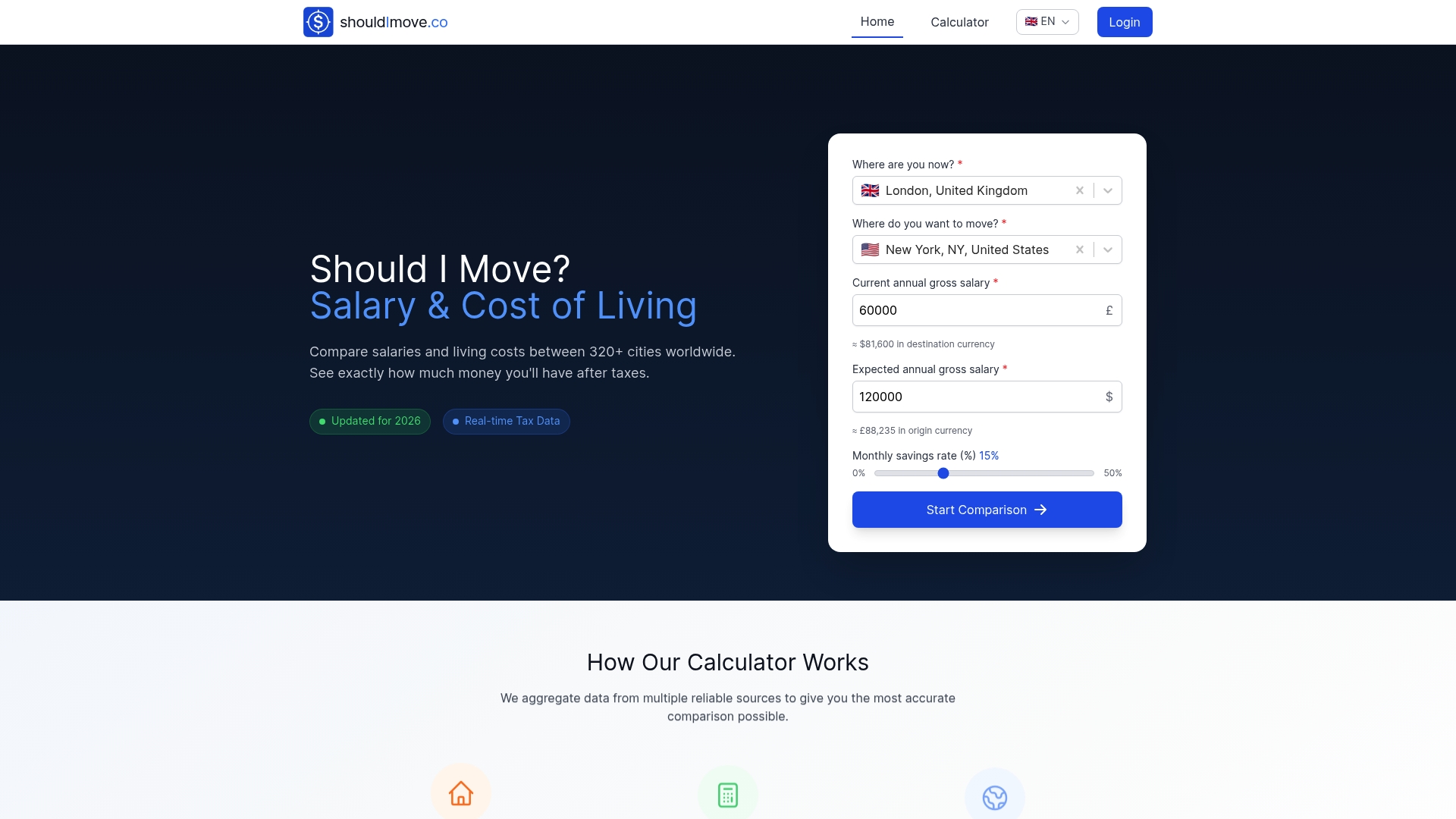
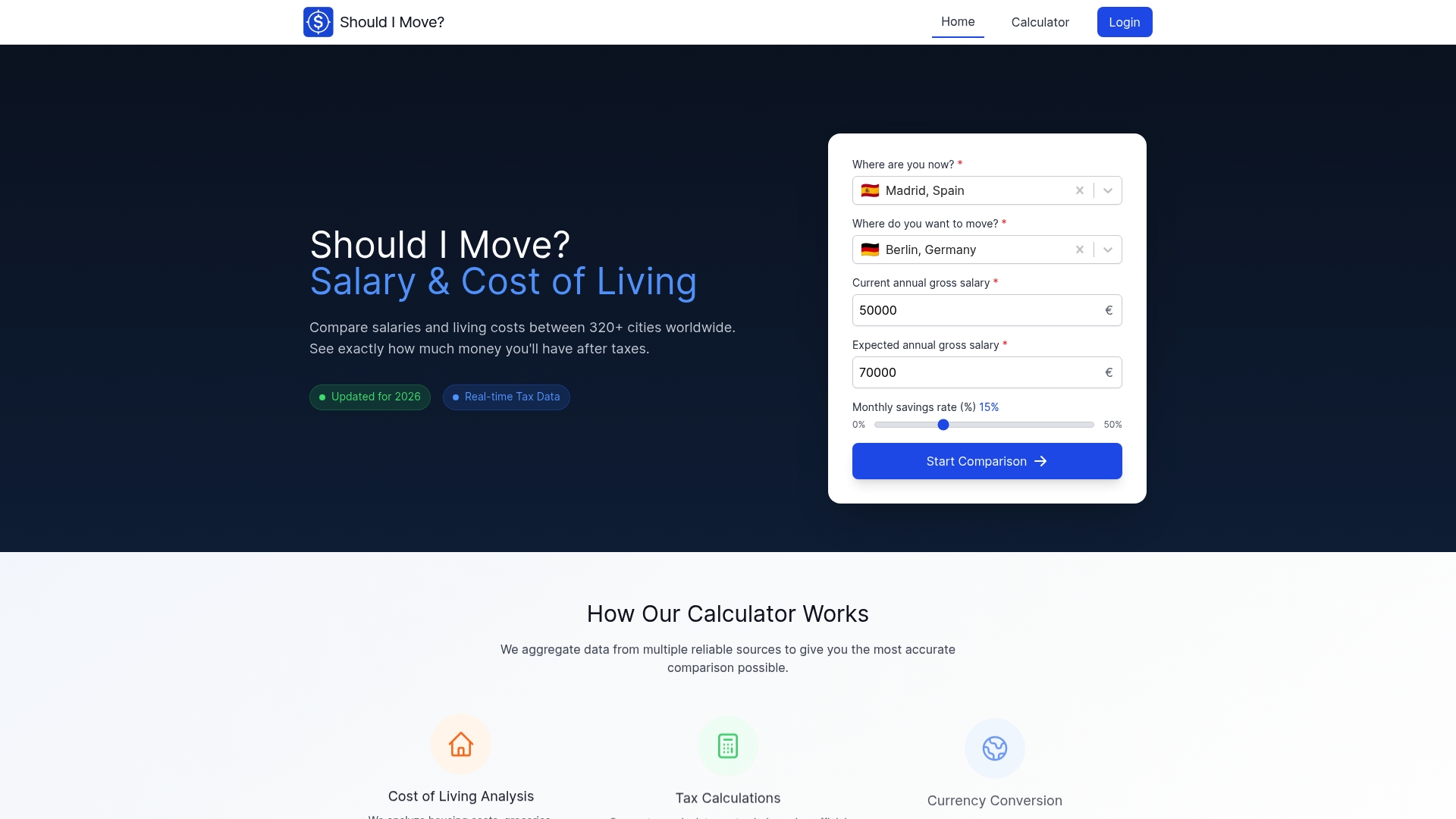
ShouldIMove compares net salary after taxes and the cost of living across more than 320 cities worldwide. The platform combines tax calculations with multi-currency conversion and detailed expense categories so you see side-by-side financial comparisons. It is free to use and built specifically to help people make relocation decisions based on real take-home pay rather than gross salary figures.
Core Features
ShouldIMove focuses on relocation economics. Key features include a cost of living calculator for 320+ cities, tax calculations for 48+ countries, and multi-currency support with automatic conversion. The site breaks expenses into housing, food, transportation, and entertainment so you can compare categories directly. You can also run side-by-side comparisons of net salary after taxes between two locations.
Pros
- Net salary focus: Unlike most tools that only show cost of living, ShouldIMove calculates take-home pay after taxes for direct comparison.
- Multi-currency support: Automatic currency conversion shows equivalent purchasing power across locations.
- Free with no registration: You can run comparisons instantly without creating an account or entering payment details.
- Tax calculations for 48+ countries: Built-in tax engines handle income tax, social security, and local taxes.
Cons
- Limited to financial data — does not cover quality of life factors like safety, healthcare ratings, or climate.
- Expense data comes from Numbeo, so accuracy depends on that source's crowdsourced inputs.
- No mobile app — browser-only experience.
- City coverage (320+) is smaller than Numbeo's database for less common destinations.
Who It's For
Digital nomads, remote workers, and American professionals planning a move to European cities will get the most value. If you are deciding between job offers in different countries or trying to decide whether relocating makes financial sense, ShouldIMove gives the concrete numbers you need. Use it when you want transparent comparisons rather than rough estimates.
Unique Value Proposition
ShouldIMove focuses on the money that actually lands in your bank account. Most competitors show either price lists or tax tables separately. ShouldIMove links both data sets — taxes and living costs — and presents the combined outcome so you can compare net disposable income across cities in one view.
Real World Use Case
Imagine you have a tech offer in Berlin and another in Lisbon. Enter both cities, input gross salary, and you instantly see how taxes and living expenses shift your monthly budget. You can compare rent differences, grocery costs, and take home pay in local currency or US Dollars to reach a fact based decision.
Pricing
The platform is free to use with no registration required. This removes friction when you need quick, reliable comparisons.
Website: https://shouldimove.co
TheLivingCost
At a Glance
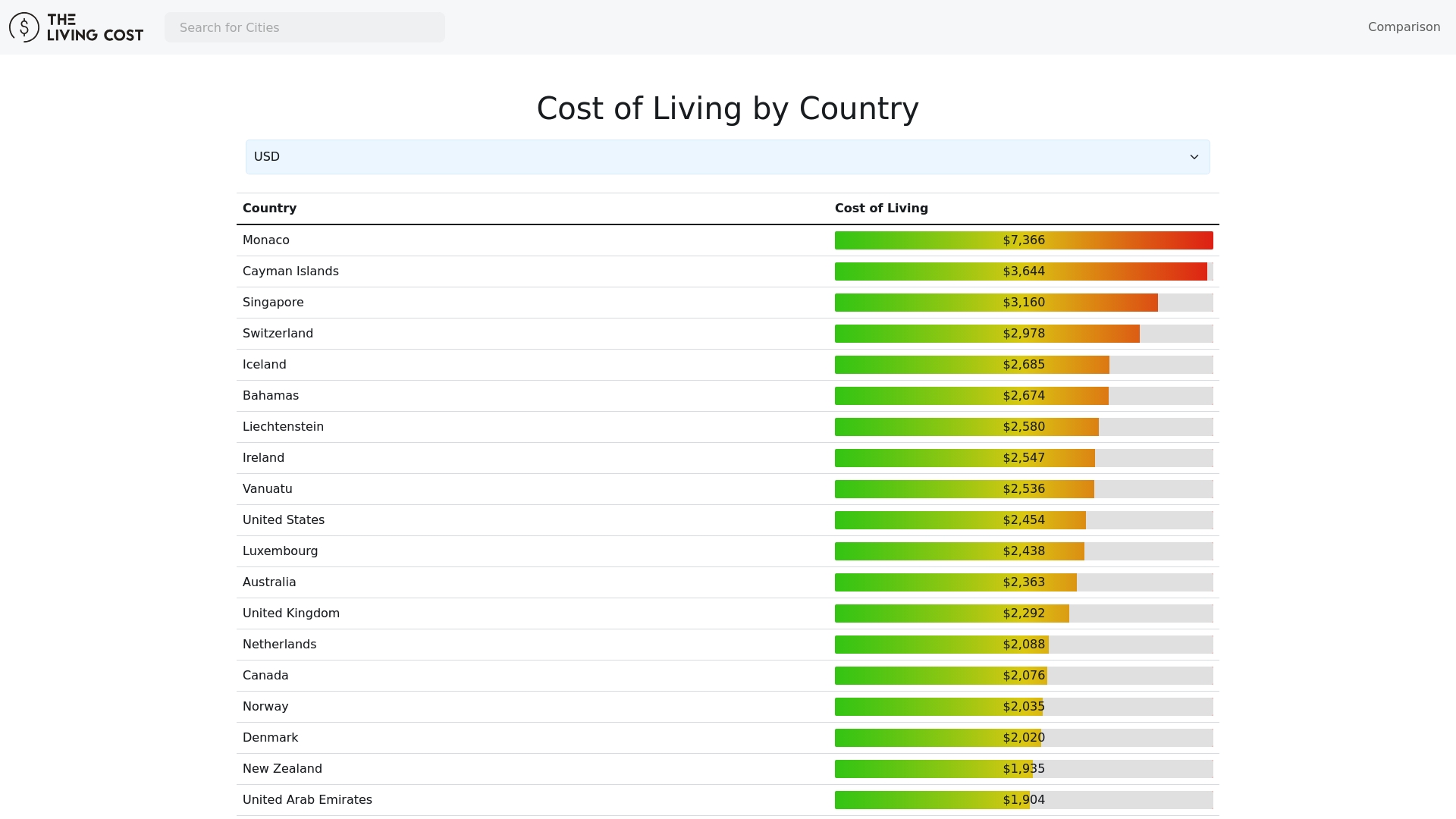
TheLivingCost offers clear cost of living comparisons and detailed country-specific cost data to help you weigh relocation choices. The site presents country profiles with straightforward figures and currency options so you can compare affordability quickly. For digital nomads and remote workers who need a high level view of expenses, this is a fast way to see relative costs across countries. Short and practical.
Core Features
TheLivingCost focuses on country to country comparisons with an emphasis on overall affordability and cross currency presentation. It provides detailed profiles that summarize typical national expenses and allows navigation via country links for deeper inspection. The platform keeps the interface simple so you spend time planning rather than hunting for data.
Pros
- Comprehensive country coverage: The site lists numerous countries so you can compare many relocation options in one place.
- Free access to core data: All cost profiles and comparison tools are available without a paywall which removes a barrier for planners.
- Easy comparison workflow: The layout and country links let you jump between locations quickly which speeds up preliminary research.
- Currency display options: Showing figures in different currencies helps you assess purchasing power and exchange impacts at a glance.
- Up to date cost snapshots: The site aims to refresh numbers so you are working with recent estimates when budgeting for a move.
Cons
- The site provides limited context about what drives each country figure which makes it harder to trust line item accuracy.
- It lacks detailed breakdowns for specific expenditure categories like housing, transportation, and groceries which you need for precise monthly budgets.
- Interactive features are minimal so you cannot customize scenarios or model salary versus expense trade offs on site.
- The data update frequency and methodology are not fully transparent which creates uncertainty for financial planning.
- Availability has been unreliable: when we last checked (August 2026), the site was returning server errors, so plan a backup source.
Who It's For
TheLivingCost works well for people considering relocation across countries who want quick comparative snapshots. It suits students, expatriates, and travelers planning long term stays who need a top level sense of affordability. Financial planners and researchers will find it useful as a starting point before deeper analysis.
Unique Value Proposition
TheLivingCost delivers an uncluttered place to compare national living costs across multiple currencies without a paywall. Its strength is fast, broad coverage that helps you rule locations in or out before committing to deeper research. That efficiency saves time when you are vetting several countries.
Real World Use Case
You plan to move to Canada and want a quick budget comparison against your current country. Use TheLivingCost to view Canada side by side with other options to estimate relative cost differences and shortlist cities for further research. Then follow up with detailed housing and salary tools to build a precise relocation budget.
Pricing
Free access to all features.
Website: https://thelivingcost.com
Numbeo
At a Glance
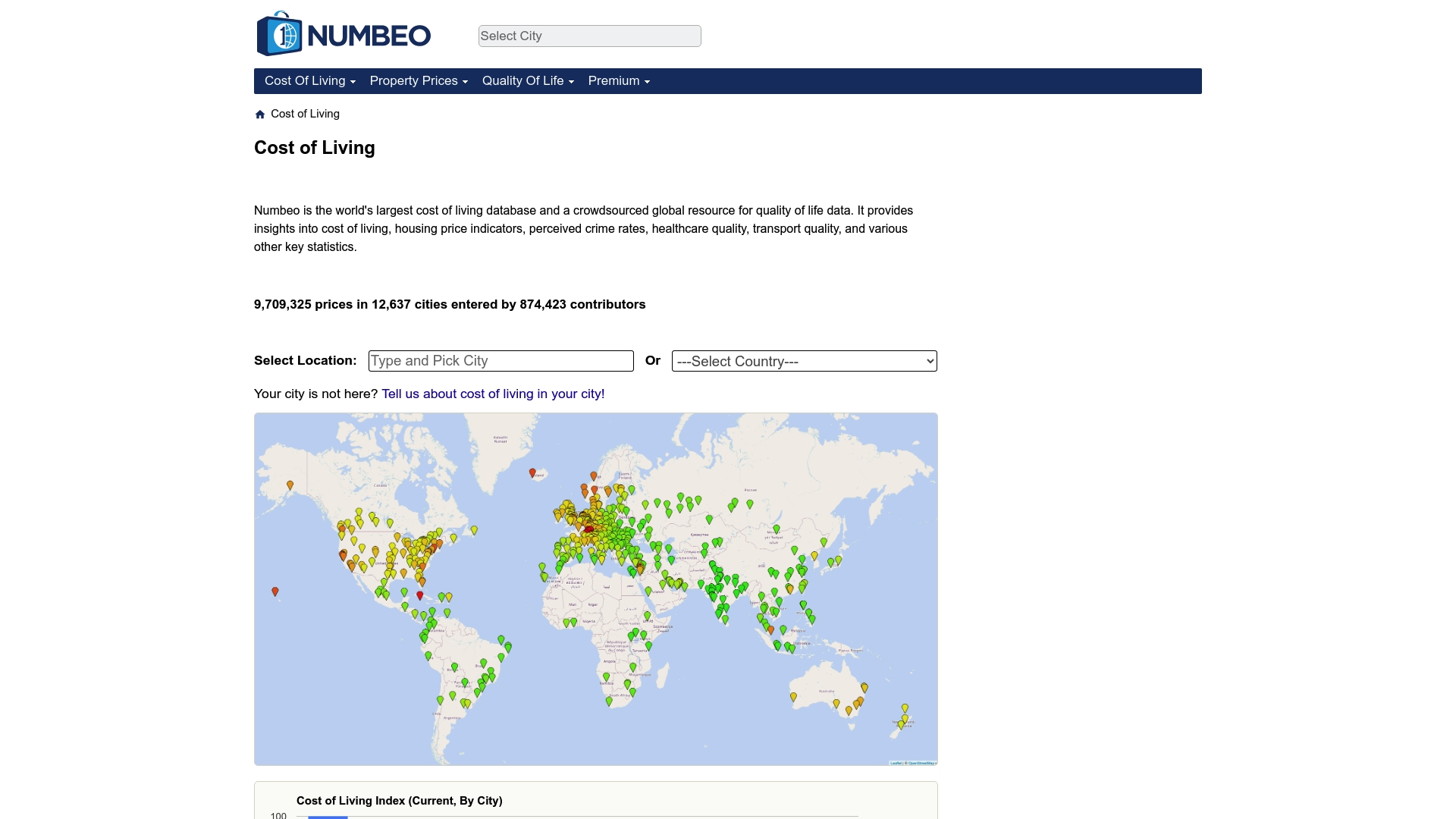
Numbeo is a crowdsourced database offering one of the largest collections of global cost of living and quality of life metrics. It gives you current price information, indices such as the Cost of Living Index, and broad geographic coverage that helps you compare cities and countries side by side. The platform's strength lies in rapid user contributed updates that keep many local prices fresh. For digital nomads and remote workers from the United States planning a move to Europe, Numbeo is a fast way to check take home pay implications and daily expenses before you sign a lease.
Core Features
Numbeo lets you view current price information and contributes data through a crowdsourcing model. The site offers tools for systematic research on cost of living and property markets and calculates indices like Local Purchasing Power. Users can run comparisons across cities and countries and use the global dataset for economic research. The platform also aggregates statistics on crime, healthcare quality, and transport to broaden the financial picture beyond simple price lists.
Pros
- Comprehensive global cost of living data gives you wide coverage when comparing major European cities to American home bases.
- Crowdsourced for accuracy means local residents and recent movers update prices often, which keeps many entries current.
- User contributed updates keep data current and allow for rapid reflection of inflation or seasonal price shifts.
- Various tools for comparison and analysis let you calculate indices and compare housing and grocery costs across locations.
- Extensive geographic coverage helps you research both large capitals and many smaller cities you might consider relocating to.
Cons
- Data accuracy depends on user contributions and some entries can reflect limited samples or biased reporting.
- There is limited detailed data for some less populated areas so you may not find reliable breakdowns for small towns.
- Premium features require subscription which means some useful tools and API access sit behind a paywall.
Who It's For
Numbeo is ideal for individuals, researchers, and businesses that need a broad, crowdsourced view of living costs and quality of life globally. Remote workers and digital nomads from the United States who want to compare specific European cities for housing and daily budgets will find it especially useful. Researchers doing economic or market analysis also benefit from the large dataset for cross city comparisons.
Unique Value Proposition
Numbeo stands out by combining a very large user base with simple comparison tools and public indices. The platform makes it easy to move from a high level estimate to more detailed price checks through user contributed entries. That mix of scale and ongoing updates is valuable when you must make quick relocation decisions.
Real World Use Case
A U S remote worker considering Lisbon can use Numbeo to compare rent levels, grocery costs, and healthcare quality against their current city. They can adjust the comparison with the Cost of Living Index and Local Purchasing Power to estimate take home pay requirements and monthly budget needs before accepting a job or signing a lease.
Pricing
Most features are free while premium services and API access are paid. That model lets casual users run basic comparisons without cost while power users and businesses can pay for enhanced data and integrations.
Website: https://numbeo.com
Expatistan
At a Glance
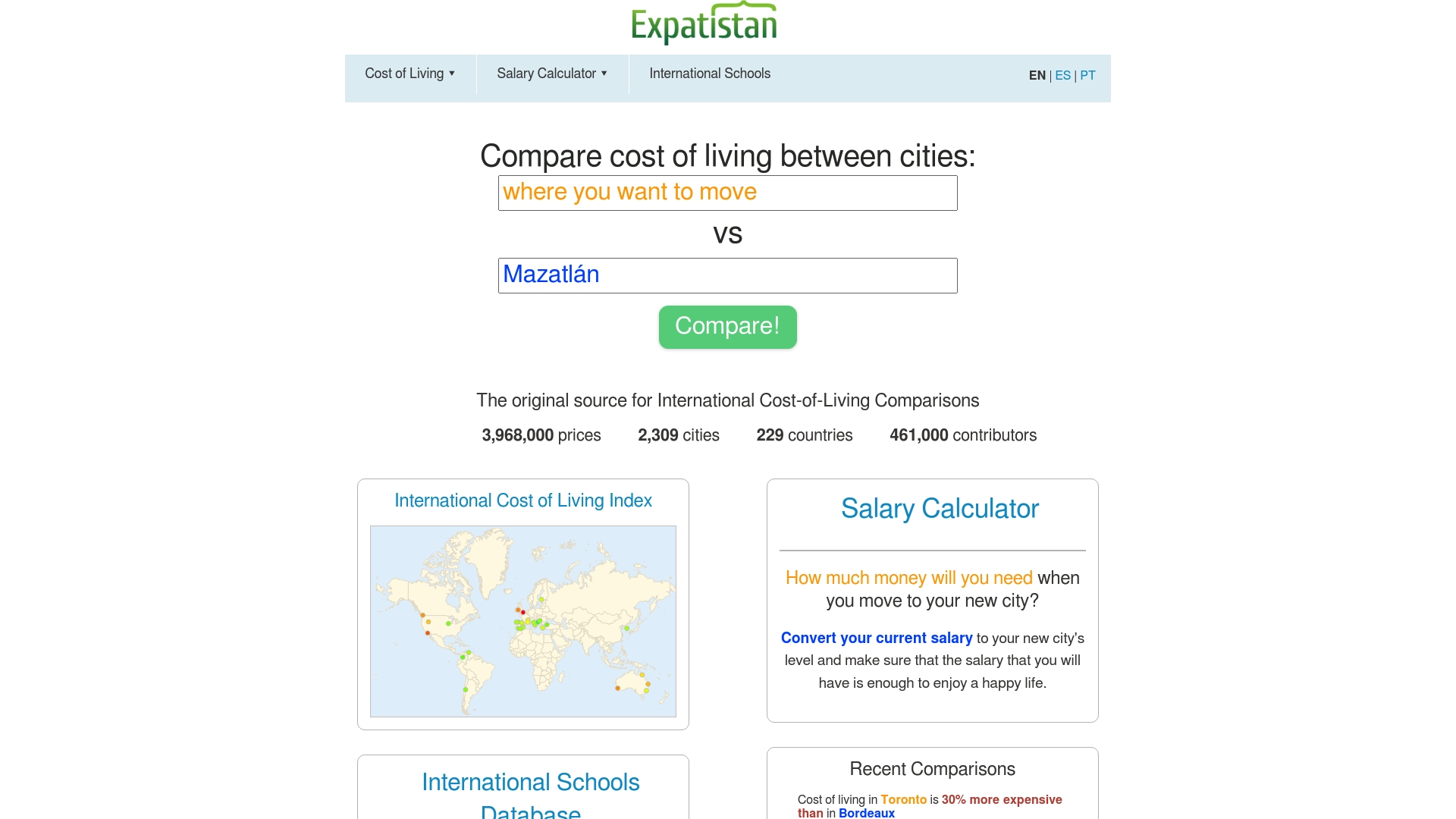
Expatistan gives a clear, no frills view of cost of living comparisons across cities worldwide. The site focuses on granular categories such as housing, food, and transportation so you can test whether a salary will cover your monthly expenses. The interface stays simple and direct which makes side by side comparisons fast. Overall this is a practical tool for planning relocation budgets.
Core Features
Expatistan centers on four core capabilities. It delivers detailed expense categories covering housing, food, transportation, and more. It lets you compare multiple cities at once with an easy interface and it maintains a database of city specific cost information. The platform also notes temporary security verification which indicates attention to user safety and data integrity.
Pros
- Comprehensive cost data. The database includes many expense types so you can break down a monthly budget with real line items.
- Easy city comparison. The site makes it straightforward to view two or more cities side by side for quick decision making.
- Useful for many audiences. Expats, travelers, and students will find the comparisons relevant to relocation or trip planning.
- Regular updates. The platform states that information is regularly updated which helps keep estimates current.
- Detailed breakdowns. Expense categories let you isolate housing or food costs when you need precise numbers.
Cons
- Relies on user contributed data which may vary in accuracy. Crowdsourced inputs can create inconsistent results between cities.
- Limited scope outside cost metrics. The platform focuses on living costs and lacks broader lifestyle or quality of life indicators.
- Some features may require registration. You may need to sign up to access certain data or tools.
Who It's For
Expatistan targets Expats, travelers, students, HR managers, and financial advisors who need clear cost comparisons. If your main question is whether a proposed salary covers rent, food, and transit in another city this tool gives the numbers you need. It fits users who want straightforward financial inputs rather than long lifestyle reports.
Unique Value Proposition
Expatistan stands out for its focused approach to numerical cost comparisons and its depth of expense categories. The site trades bells and whistles for a compact experience that surfaces the specific costs that matter when you plan a move or an assignment. The presence of regular updates and simple comparison tables makes it efficient for budgeting.
Real World Use Case
A person considering a move from New York City to Berlin uses Expatistan to compare rent, groceries, and transport costs. The side by side numbers help them estimate whether their current salary will sustain a similar standard of living in Berlin and inform negotiations with a prospective employer.
Pricing
Expatistan provides free access to basic cost of living comparison data which covers the core comparison tools and expense breakdowns. There is no charge to view standard city comparisons.
Website: https://expatistan.com
Livingcost.org
At a Glance
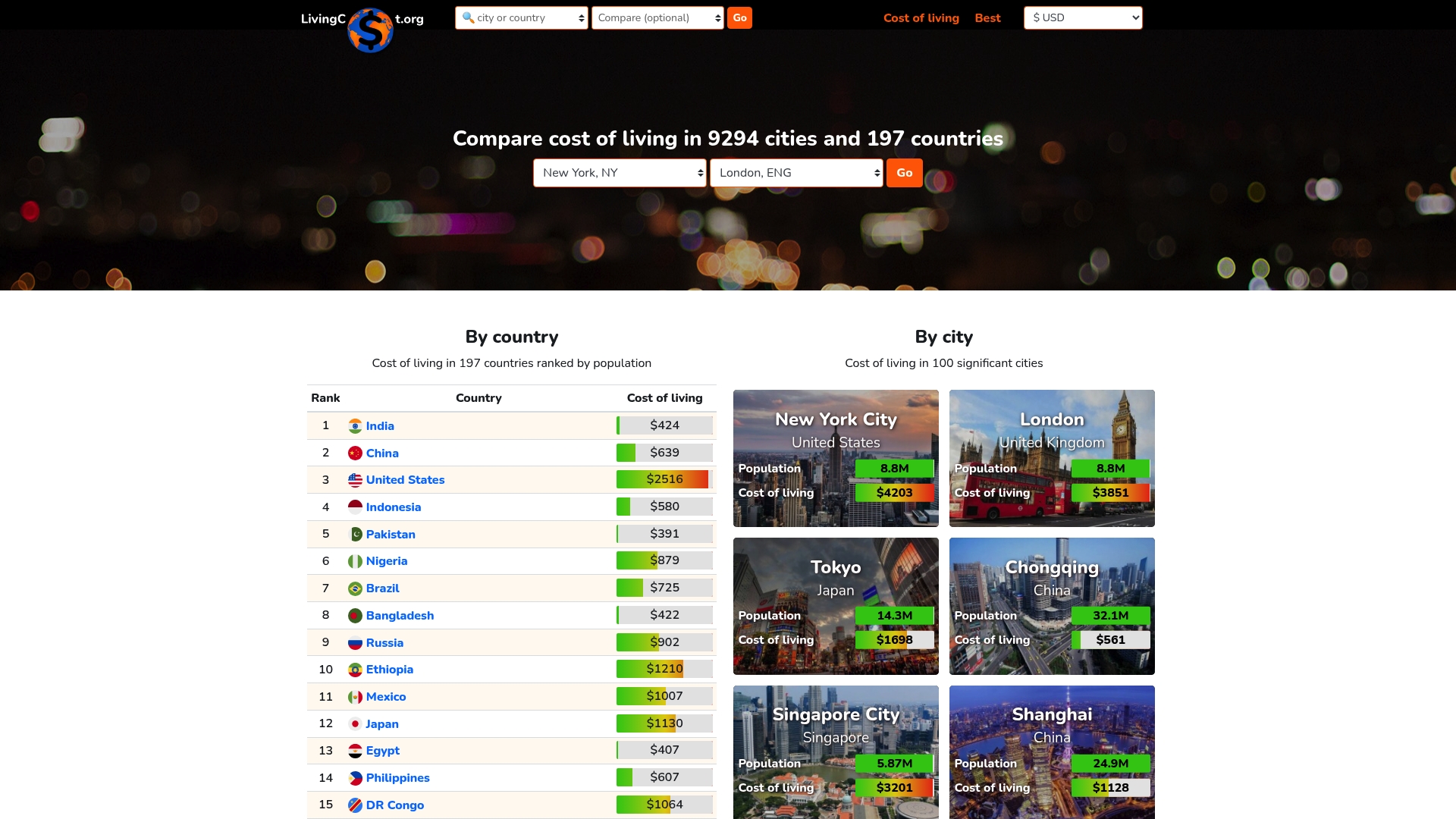
Livingcost.org is a crowdsourced database that lets you compare cost of living across more than 9,000 cities in 197 countries. The site provides a detailed consumer basket for a moderate lifestyle and a cost of living calculator that helps estimate monthly expenses in different locations. Data comes from user contributions so the coverage is broad and often current. Use it when you need a fast, comparative picture of expenses before you pack for a move.
Core Features
Livingcost.org focuses on practical comparison tools for movers and remote workers. It lists cost of living for over 9,000 cities across 197 countries and offers a price comparison calculator that converts values across multiple currencies including USD EUR and GBP. The platform also produces rankings for the best places to live based on affordability and relies on crowdsourced data for price updates. Those core tools make it easy to scan many cities and filter by basic budget categories.
Pros
-
Extensive global coverage means you can research most cities you are considering for relocation and compare them side by side.
-
Crowdsourced and up to date data allows rapid updates from local contributors which helps capture recent price shifts in rent and groceries.
-
Useful for relocation and travel planning because the consumer basket models a moderate lifestyle that many remote workers find realistic.
-
Multiple currencies available for comparison reduce conversion guesswork when you plan finances in USD while earning in another currency.
-
Detailed city and country rankings give a quick sense of where your money will stretch based on affordability metrics.
Cons
-
Data accuracy depends on crowdsourcing which means some city entries can be sparse or inconsistent depending on contributor activity.
-
Cost of living may not fully represent individual lifestyle or income levels and the default basket could understate or overstate your personal spending.
-
Limited information on specific local conditions leaves gaps on issues like neighborhood safety or local tax rules which matter for long term relocation.
Who It's For
This site fits individuals and professionals who need wide coverage and quick comparisons when shortlisting cities. Digital nomads and remote workers from the United States who are weighing European cities can use the tool to compare rent grocery and transport costs before committing to a flight or long term lease. Researchers and employers assessing international locations will also find the raw comparisons helpful.
Unique Value Proposition
Livingcost.org combines a very large city database with a simple calculator and affordability rankings so you get broad comparative context in one place. The crowdsourced model gives rapid local snapshots that central sources may miss which makes it useful for initial scouting and quick sanity checks.
Real World Use Case
A remote worker uses Livingcost.org to compare monthly expenses in New York London and Tokyo to decide the most affordable relocation option. They plug in the same consumer basket and currency to see rent and grocery differences and then cross check the rankings before contacting employers or landlords.
Pricing
Livingcost.org is free to use which makes it an easy first stop when you begin relocation research. There is no paywall to view city listings or run basic comparisons.
Website: https://livingcost.org
Wise (formerly TransferWise)

At a Glance
Wise offers international money transfer, multi currency accounts, and expense management tools designed for transparent low cost global money movement. The service emphasizes transparent fees and competitive exchange rates so you see what you pay and why. Transfers are fast for many routes with most arriving in under 20 seconds, which matters when cash flow is time sensitive. Bottom line: Wise is a practical choice for remote workers and digital nomads who move money across borders often and want clarity on costs.
Core Features
Wise combines several core capabilities for cross border finance. You can send money securely and quickly internationally and receive payments in multiple currencies into a single account. The platform lets you hold and convert balances across currencies and use a Wise Multi Currency Card to spend abroad without hidden markup. For USD GBP and EUR balances, Wise offers interest earning options where available which adds a yield layer to idle balances.
Pros
- Transparent, competitive exchange rates make it easy to compare actual conversion costs against bank rates and avoid surprises.
- Low and clear fee structure helps you budget transfers because fees are shown up front rather than buried.
- Fast transaction times mean many transfers complete in under 20 seconds which reduces waiting when you need funds quickly.
- Wide range of currencies and countries served supports freelancers and remote workers who invoice clients in multiple currencies.
- Personal and business account options provide features tailored to solo contractors and companies managing payroll or supplier payments.
Cons
- Fees vary depending on the type and amount of transfer which makes exact cost comparisons less straightforward without checking the fee calculator first.
- Interest earning features are not available to residents of New York and Alaska which limits benefits for some US based users.
- Some services like interest and investment adjacent products involve added risk and are not suitable for all users who prefer deposit style safety.
Who It's For
Wise fits individuals and businesses that need low cost transparent international transfers and multi currency management. You are a freelance digital nomad or remote worker paid in Euros Pounds or other currencies and want to convert to USD without hidden bank markups. You are a small business running cross border payroll or paying international contractors and you value predictable fees and clear exchange math.
Unique Value Proposition
Wise centers on clarity and real mid market exchange rates so users see the true cost of moving money. The combination of multi currency balances, easy conversion tools, and a physical card for spending abroad means you get an integrated way to receive spend and move funds across borders without switching services.
Real World Use Case
A freelance digital marketer in the US receives monthly invoices in Euros from European clients. They keep a Euro balance for short term needs convert at the real mid market rate when convenient and spend with the Wise Multi Currency Card while traveling. This workflow reduces conversion fees and speeds access to cash when client payments arrive.
Pricing
Pricing varies by service with fees shown transparently as either a percentage of the transfer amount or flat fees for specific corridors. Discounts apply for large amounts and detailed pricing is available on the Wise website.
Website: https://wise.com
Cost of Living and Salary Comparison Tools
To assist users in comparing tools for evaluating net salary and cost of living across different cities and countries, the table below summarizes features, benefits, and limitations.
| Product | Key Features | Pros | Cons | Pricing |
|---|---|---|---|---|
| ShouldIMove | Net salary, cost of living across 320+ cities, tax calculations for 48+ countries. | Net salary focus; multi-currency support; free, no registration; combines taxes with living costs. | Financial data only; no quality of life metrics; smaller city database than Numbeo; no mobile app. | Free |
| TheLivingCost | Cost of living comparisons between countries. | Comprehensive country coverage; free access to data; quick navigation; updated cost snapshots. | Limited context for factors behind costs; lacks detailed expense breakdowns; few interactive features. | Free |
| Numbeo | Crowdsourced global database with cost of living indices. | Extensive data coverage; user-updated content regularly; comparative indices for costs and salaries. | Data dependability varies; smaller towns may lack details; premium features behind paywall. | Free, premium options present |
| Expatistan | Clear city-by-city cost comparisons. | Detailed expense categories; helpful for expatriates and relocation planning; regularly updated pricing. | Focused solely on expenses; data consistency may vary. | Free |
| Livingcost.org | Cost comparisons for 9,000+ cities; affordability rankings based on crowd-sourced price updates. | Large dataset covering major cities; effective overview for relocation research; frequent updates by contributors. | Crowdsourced inputs may vary in reliability; limited in-depth local information. | Free |
| Wise | Transparent international currency exchange and money movement; fast transactions. | Low fees; competitive exchange rates; multi-currency account available; personal and business use. | Interest options restricted to certain users; transfer fees vary. | Free, pay-per-use |
Which Tool Should You Use?
Each platform above serves a different purpose. If you need a quick country-level overview, TheLivingCost or Livingcost.org will get you started. For granular city-by-city price data, Numbeo and Expatistan have the largest databases — and if you want a more detailed comparison of Numbeo specifically, our guide to Numbeo alternatives for cost of living tools covers 7 platforms with a feature comparison table and a scenario-based decision guide. If you are moving money across borders, Wise handles the currency side.
Where most tools stop at listing prices, ShouldIMove.co connects the dots between your gross salary, local taxes, and daily expenses to show what actually lands in your bank account each month. Try running a comparison for your current city against a potential destination — the difference between gross salary and real disposable income is often surprising.
Frequently Asked Questions
What should I consider when choosing an alternative to thelivingcost.com for financial comparisons?
Choosing an alternative requires evaluating the accuracy and depth of data for living costs and salaries. Look for platforms that offer detailed breakdowns in categories like housing, transportation, and food, which can help you create a realistic budget based on local expenses.
How can I effectively use salary comparison tools when researching relocation options?
Utilize salary comparison tools by inputting your gross salary and comparing it against the cost of living in potential new locations. This process helps you assess whether your take-home pay will cover your monthly expenses, allowing for informed decision-making.
What types of financial metrics should I look for when assessing living cost alternatives?
Seek platforms that provide comprehensive metrics such as the Cost of Living Index, housing prices, transportation costs, and food expenses. Additionally, look for real-time data updates to ensure your comparisons reflect current economic conditions.
How do I interpret cost of living data from different sources for my relocation decisions?
When interpreting cost of living data, focus on the specific categories that matter most to you, like rent and daily expenses. By comparing these metrics across several sources, you can gauge discrepancies and make more informed financial decisions regarding relocation.
Are there specific features that enhance the functionality of living cost comparison tools?
Yes, look for features like multi-currency support, customizable budget scenarios, and detailed expense breakdowns, which can add significant value. These tools can help you simulate different financial situations based on your unique salary and lifestyle choices.
How can I ensure the accuracy of the data I find on living cost comparison platforms?
To ensure data accuracy, cross-reference information from multiple platforms, focusing on user-contributed updates and verified sources. By consistently reviewing and comparing data, you can gain a clearer understanding of the cost dynamics in your prospective new city.