
A job offer of $75,000 sounds the same whether you open it in Berlin, Lisbon, or Dubai. But after taxes and local expenses, those three numbers look nothing alike. In Berlin, you might take home around $45,000 after income tax and social contributions. In Lisbon, closer to $47,000. In Dubai, the full $75,000 — because there is no income tax.
For expats and remote workers, salary negotiation is not just about the number on the contract. It is about what that number buys after local taxes, rent, groceries, and currency conversion. Here are seven things you should keep in mind before accepting or negotiating any offer abroad.
Table of Contents
- 1. Research Local Salary Ranges with Real Data
- 2. Calculate Your Net Pay — Not Just Gross
- 3. Benchmark Against Local Cost of Living
- 4. Account for Currency and Purchasing Power
- 5. Use Remote Work Flexibility as a Negotiation Tool
- 6. Negotiate Relocation and Housing Support
- 7. Lock in Salary Adjustment Mechanisms
Quick Summary
| What to Keep in Mind | Why It Matters |
|---|---|
| Research local salary ranges | A "competitive" offer in one city may be below market in another. Local data prevents undervaluing yourself. |
| Calculate net pay | Tax rates vary from 0% (Dubai) to nearly 50% (Belgium). The same gross salary produces wildly different take-home pay. |
| Benchmark cost of living | $4,000/month after tax covers a comfortable life in Lisbon but barely covers rent in Zurich. |
| Factor in currency | Getting paid in USD while living in a Euro country means exchange rate shifts directly affect your budget. |
| Leverage remote flexibility | Companies save $11,000/year per remote employee on average. That savings is your negotiation leverage. |
1. Research Local Salary Ranges with Real Data
Before any negotiation, you need to know what the local market actually pays for your role. A senior developer earning $130,000 in San Francisco is roughly at market rate. The same role in Barcelona might pay $55,000-70,000 — not because the work is different, but because local salary structures reflect local economies.
Where to find reliable data:
- Glassdoor and Levels.fyi for role-specific salary ranges by city
- ILOSTAT for country-level wage statistics adjusted for inflation
- LinkedIn Salary Insights for industry-specific benchmarks
- Payscale for experience-adjusted compensation data
The key is to compare your role in your target city — not national averages or cross-industry figures. A "data analyst" salary range differs significantly between fintech in Amsterdam and manufacturing in Warsaw.
How to use this data in negotiation: When an employer offers $60,000 for a role in Dublin, and your research shows the median is $68,000-72,000, you have a concrete basis. Say: "Based on market data from [source], similar roles in Dublin pay $68,000-72,000. I'd like to discuss aligning this offer with the local market."
Anchoring your ask to third-party data shifts the conversation from personal opinion to market reality.
2. Calculate Your Net Pay — Not Just Gross
A $70,000 offer sounds identical everywhere. Here is what it actually looks like after taxes:
| City | Gross Salary | Approx. Net Salary | Effective Deduction Rate |
|---|---|---|---|
| Dubai | $70,000 | $70,000 | 0% |
| Singapore | $70,000 | $66,500 | ~5% |
| Lisbon | $70,000 | $44,400 | ~37% |
| Berlin | $70,000 | $43,100 | ~38% |
| Brussels | $70,000 | $39,000 | ~44% |
The spread between the highest and lowest net pay is over $31,000 per year — for the exact same gross salary.
What to calculate before negotiating:
- Income tax in the destination country (check brackets — progressive systems mean your effective rate differs from the top marginal rate; our step-by-step guide to calculating net salary abroad walks through the full method)
- Social security contributions — in Germany this adds roughly 20% on top of income tax
- Tax residency rules — most countries trigger residency after 183 days, but rules vary
- Double taxation treaties — if your employer is in a different country than your residence, check whether a bilateral treaty exists
For remote workers moving from the US, remember that the US taxes citizens on worldwide income regardless of where you live. You may qualify for the Foreign Earned Income Exclusion (up to $132,900 in 2026), but social security obligations can remain. If you are self-employed or freelancing internationally, the tax picture changes significantly — our freelancer tax comparison across 12 European countries breaks down the effective rates including income tax, social contributions, and health insurance for independent workers.
In negotiations: If an employer offers the "same salary" for a role that moves from London to Berlin, point out that German social contributions are higher. Ask for a gross-up to maintain equivalent net pay.
3. Benchmark Against Local Cost of Living
Net salary is only half the equation. What matters is what is left after you cover rent, food, transport, and utilities.
Example: A software engineer earning $4,500/month net in Lisbon and another earning $5,800/month net in Munich might assume the Munich job is better. But typical monthly expenses tell a different story:
| Expense | Lisbon | Munich |
|---|---|---|
| 1-bed apartment (city center) | $1,100 | $1,800 |
| Groceries | $350 | $450 |
| Transport pass | $45 | $80 |
| Utilities | $120 | $250 |
| Total basic costs | $1,615 | $2,580 |
| Remaining disposable income | $2,885 | $3,220 |
The gap narrows from $1,300 (net salary difference) to just $335 in actual disposable income. And Lisbon offers a lower cost for dining, entertainment, and healthcare.
How to use this in negotiations: Frame your ask in terms of disposable income, not gross salary. If an employer says "We are offering market rate for Prague," and your research shows that Prague rents have risen 25% since 2023, you can argue for an adjustment that reflects current conditions — not the last time they hired in that city.
Tools like ShouldIMove.co let you compare net salary against living expenses across 320+ cities, which gives you a concrete number to bring to the table.
4. Account for Currency and Purchasing Power
If you earn in one currency and spend in another, exchange rate fluctuations become a real budget risk. A remote worker earning $6,000/month in USD while living in the Eurozone saw their effective income drop by ~8% between mid-2021 and late-2022 as the euro weakened, then recover when it strengthened again.
Three scenarios to consider:
- Paid in local currency, spending locally — no exchange risk, but your savings in your home currency fluctuate
- Paid in USD/GBP, spending in another currency — your daily budget changes with exchange rates
- Split income across currencies — the most complex scenario, common for freelancers with clients in multiple countries
Purchasing Power Parity (PPP) matters more than the raw exchange rate. According to OECD PPP data, $1 buys roughly the same goods in the US as $0.65 does in Portugal — meaning your dollar stretches further in Lisbon than the exchange rate alone suggests.
Negotiation tactic: If you are being paid in a volatile currency or earning in a different currency than you spend, negotiate either a currency adjustment clause or request payment in a stable currency. Some contracts include quarterly exchange rate reviews with a ±5% adjustment band.
5. Use Remote Work Flexibility as a Negotiation Tool
Remote work is not just a perk — it produces measurable savings for employers. Global Workplace Analytics estimates that employers save an average of $11,000 per year for each employee who works remotely half the time. That covers reduced office space, utilities, and overhead.
How to frame this:
Instead of "I want to work remotely," try: "By working remotely, the company saves on office costs for my role. I'd like to discuss allocating part of that savings toward a higher base salary or a remote work stipend."
This reframes the conversation from a concession to a mutual benefit.
Specific benefits to highlight:
- Office space in London averages $800-1,200/month per desk. Your remote arrangement eliminates that.
- No commuter benefits or parking to subsidize.
- Access to talent outside expensive metro areas (the employer's original motivation for hiring remotely).
If the employer cannot increase base salary, remote flexibility opens doors to other compensation: home office stipend ($1,000-3,000/year is common), coworking space allowance, or equipment budget.
6. Negotiate Relocation and Housing Support
Moving internationally is expensive. A typical corporate relocation from the US to Western Europe costs $20,000-50,000 when you factor in visa fees, shipping, temporary housing, flights, and setup costs. Even a local move between European cities can run $5,000-10,000.
What to negotiate:
| Benefit | Typical Range | Notes |
|---|---|---|
| Visa and work permit processing | $2,000-8,000 | Employer should cover legal fees |
| Temporary housing (1-3 months) | $3,000-9,000 | Critical while searching for permanent housing |
| Moving/shipping costs | $3,000-15,000 | Depends on volume and distance |
| Flight costs (family) | $1,000-5,000 | Round trip for you and dependents |
| Home search trip | $1,500-3,000 | 3-5 days to view apartments in person |
| Lease break assistance | $1,000-3,000 | If leaving a current lease early |
Many employers offer a lump sum relocation allowance instead of itemized benefits. If offered a lump sum, ask for the gross-up: relocation payments are often taxable income, so a $15,000 allowance might only net you $10,000 after tax.
Timing matters. Negotiate relocation support before accepting the offer, not after — our breakdown of the real cost of moving abroad itemizes what those one-time expenses actually add up to, so you can put a number on the ask. Once you have signed, your leverage drops significantly.
7. Lock in Salary Adjustment Mechanisms
A competitive salary in year one can fall behind within two years if there is no adjustment mechanism. This is especially relevant for expats because:
- Inflation varies by country. Turkey saw 50%+ inflation in recent years. Even stable economies like Germany hit 6-7% in 2022-2023.
- Cost of living shifts. Lisbon rents increased roughly 30% between 2021 and 2025 as the city attracted more remote workers.
- Currency fluctuations erode purchasing power if you are paid in a different currency than you spend.
What to ask for:
- Annual cost-of-living adjustment tied to the local CPI — not a vague "we review salaries annually"
- Performance-based raises with clear metrics and timelines (e.g., "10% increase after hitting X target within 12 months")
- Market rate reviews every 18-24 months benchmarked against current salary data for your role and location
- Currency adjustment clause if paid in a different currency than your country of residence
Get these in writing. A verbal promise of "we will review next year" has no weight if your manager changes or budgets tighten. The best time to negotiate adjustment mechanisms is when you have the most leverage — before you sign.
Compare Net Salary Across Cities Before Your Next Negotiation
Every point above comes down to one thing: knowing what your salary actually buys in a specific city after taxes and expenses. That data turns a negotiation from guesswork into a fact-based conversation.
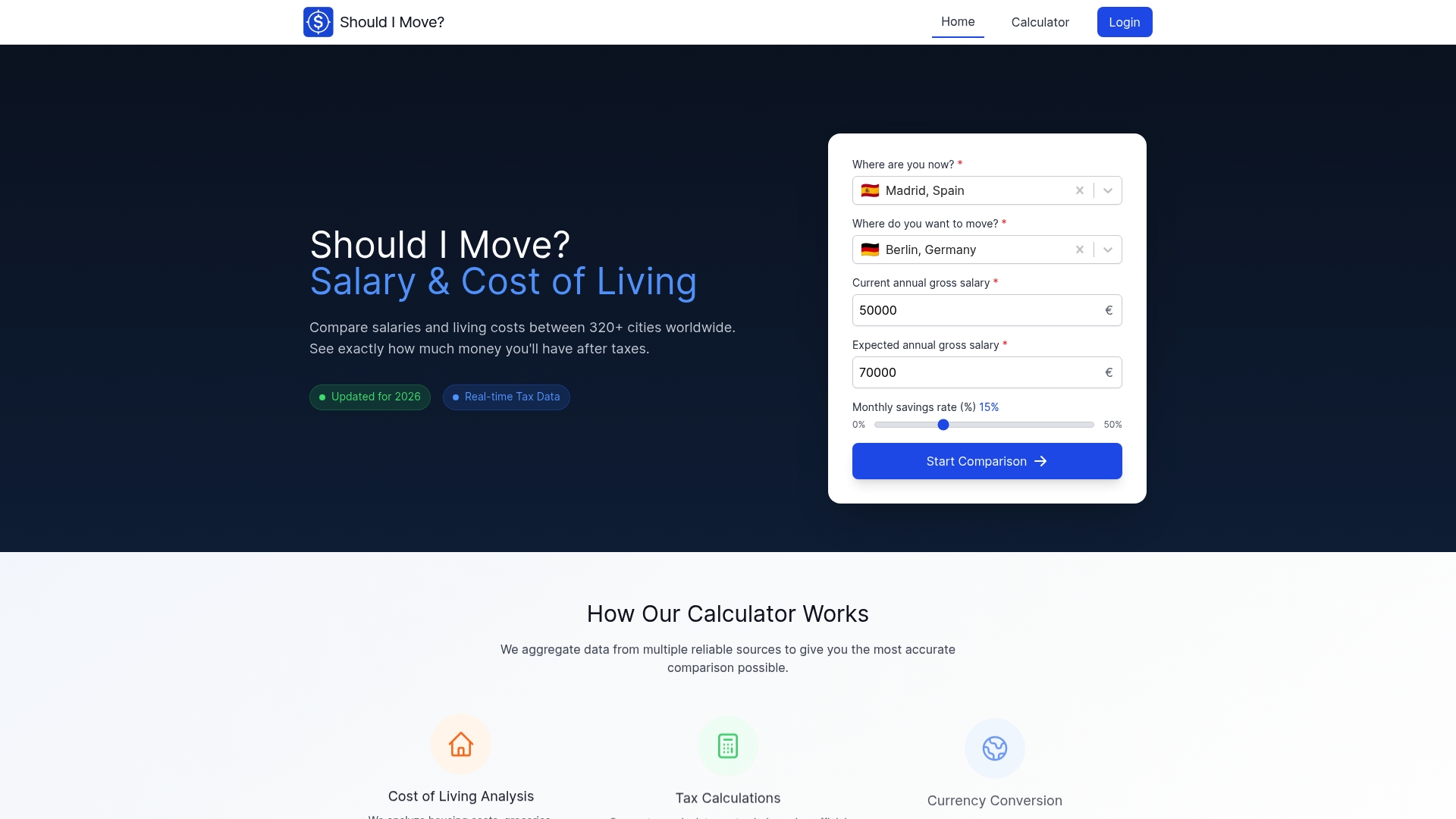
ShouldIMove.co calculates net salary after taxes and compares it against local living costs for 320+ cities. Enter your gross salary, pick two cities, and see the difference in take-home pay and disposable income. Use those numbers in your next salary conversation.
Frequently Asked Questions
How do I find accurate salary data for a specific city and role?
Start with role-specific platforms like Glassdoor or Levels.fyi for your target city, then cross-reference with ILOSTAT country-level wage data and LinkedIn Salary Insights. Use at least two sources to account for sample size differences.
What is the biggest mistake expats make in salary negotiations?
Comparing gross salaries without accounting for local taxes and social contributions. A $70,000 offer in Brussels nets roughly $39,000 after tax and social contributions, while the same gross in Dubai nets the full $70,000. Always negotiate based on net pay.
Should I negotiate for a higher salary or better benefits?
It depends on your situation. In high-tax countries, additional salary gets taxed at your marginal rate (often 40-50%). Benefits like housing allowances, relocation support, or education stipends may deliver more value because some are tax-exempt or taxed at lower rates.
How do I handle salary negotiation when I am paid in a different currency?
Request either a currency adjustment clause (quarterly reviews with an adjustment band) or payment in your local currency. If neither is possible, build a 10-15% buffer into your target salary to absorb exchange rate fluctuations.