
A job offer of $80,000 in Berlin does not equal $80,000 in Lisbon, Dubai, or Singapore. Each city applies different income tax rates, social security contributions, and mandatory deductions — and the differences are large. On the same gross salary, your annual take-home pay can vary by $30,000+ depending on where you live.
This guide walks through how to calculate your net salary abroad step by step, with real examples showing how taxes and deductions work across different countries. Whether you are comparing job offers, planning a relocation, or trying to understand what your current salary would be worth somewhere else, these steps give you the numbers you need.
Table of Contents
- Step 1: Understand the Difference Between Gross and Net
- Step 2: Determine Your Tax Residency Status
- Step 3: Identify Income Tax Rates and Brackets
- Step 4: Calculate Social Security and Mandatory Contributions
- Step 5: Account for Currency Conversion
- Step 6: Verify With Online Calculators
- Common Mistakes That Distort Your Numbers
Quick Summary
| Step | What You Calculate | Why It Matters |
|---|---|---|
| Gross vs. net | Your starting salary minus all deductions | The gross number on your contract is not what you take home |
| Tax residency | Which country taxes you and how | Determines your entire tax obligation — get this wrong and everything else is off |
| Income tax brackets | Progressive rates applied to your income | Effective tax rate is lower than marginal rate — many expats overestimate their tax |
| Social contributions | Pension, healthcare, unemployment insurance | In some countries (Germany, France) these add 20%+ on top of income tax |
| Currency conversion | What your salary buys in local currency | Exchange rate shifts can change your effective salary by 5-10% over a year |
Step 1: Understand the Difference Between Gross and Net
Gross salary is the total amount your employer agrees to pay you before any deductions. Net salary (take-home pay) is what actually lands in your bank account after income tax, social security, and other mandatory contributions.
The gap between gross and net varies dramatically by country:
| Country | Gross Salary | Approx. Net Salary | Total Deduction Rate |
|---|---|---|---|
| UAE (Dubai) | $80,000 | $80,000 | 0% |
| Singapore | $80,000 | $76,650 | ~4% |
| United Kingdom | $80,000 | $57,000 | ~29% |
| Spain | $80,000 | $53,350 | ~33% |
| Germany | $80,000 | $48,300 | ~40% |
| Belgium | $80,000 | $41,350 | ~48% |
The difference between Dubai (0% deductions) and Belgium (48% deductions) is $38,650 per year — on the exact same gross salary. This is why calculating net salary is the single most important financial step before accepting a job abroad.
What gets deducted:
- Income tax (federal and sometimes regional/municipal)
- Social security / national insurance contributions
- Mandatory healthcare contributions
- Pension fund contributions
- In some countries, solidarity surcharges or church tax
Step 2: Determine Your Tax Residency Status
Tax residency determines which country has the right to tax your income — and it is not always obvious. Most countries use one or more of these criteria:
| Method | How It Works | Countries That Use It |
|---|---|---|
| Physical presence test | You become a tax resident after spending 183+ days in a country within a calendar year | Most EU countries, Canada, Australia |
| Permanent home | Tax residency based on where your primary home is | UK, Germany, France |
| Center of vital interests | Based on family ties, economic connections, social activities | France, Italy, Spain |
| Citizenship-based | Taxed on worldwide income regardless of where you live | United States, Eritrea |
Why this matters: If you are a US citizen working in Germany, you may owe taxes in both countries. The US taxes citizens on worldwide income, though the Foreign Earned Income Exclusion (up to ~$132,900 in 2026) and foreign tax credits can reduce or eliminate double taxation.
Most countries have double taxation treaties that prevent you from paying full tax to two governments on the same income. But you need to know which treaties apply to your situation — they are not automatic.
Action step: Before accepting a position abroad, confirm:
- Where you will be considered a tax resident
- Whether a double taxation treaty exists between your home country and the new country
- Whether you need to file tax returns in both countries
Step 3: Identify Income Tax Rates and Brackets
Most countries use progressive tax systems — your income is taxed at increasing rates as it moves through brackets. This means your effective tax rate is lower than the top bracket rate.
Example: Germany (2024/2025 rates, single filer)
| Income Bracket (EUR) | Tax Rate |
|---|---|
| Up to €11,604 | 0% |
| €11,605 – €17,005 | 14% (rising) |
| €17,006 – €66,760 | 24-42% (progressive) |
| €66,761 – €277,825 | 42% |
| Above €277,825 | 45% |
On an €80,000 gross salary in Germany, the effective income tax rate works out to roughly 20% — not the 42% marginal rate that the bracket suggests. Many expats see the top rate and panic, but the progressive structure means you pay less on the income in lower brackets. When you add social security contributions (~20%), the total deduction rate reaches approximately 40%.
Compare this with a flat tax country like Bulgaria (10% flat rate on all income) or Romania (10% flat). On €80,000, a flat 10% rate means €8,000 in income tax versus roughly €16,000 in Germany. For a detailed walkthrough of how French payroll works — including cotisations, CSG/CRDS, and the quotient familial — see our guide to how the France salary calculator works.
Some countries offer special expat tax regimes:
- Netherlands: The 30% ruling lets qualifying expats receive 30% of their salary tax-free (being reduced to 27% from 2027)
- Portugal: Non-Habitual Resident (NHR) program offered reduced rates for foreign-sourced income (program has been modified — check current rules)
- Italy: Returning workers scheme with up to 50% income tax exemption for qualifying individuals (60% with minor children; reduced from 70% under 2024 reform)
- Spain: Beckham Law allows flat 24% tax rate for the first 6 years for certain expats
These special regimes can save tens of thousands per year but have specific eligibility criteria and application deadlines.
Step 4: Calculate Social Security and Mandatory Contributions
In many European countries, social security contributions are as large as — or larger than — income tax. These are easy to overlook but they significantly reduce your take-home pay.
Social security contribution rates (employee portion only):
| Country | Employee SS Rate | What It Covers |
|---|---|---|
| France | ~22% | Health, pension, unemployment, family |
| Germany | ~20% | Health (~9%), pension (~9.3%), unemployment (~1.3%), care (~1.7–2.3%) |
| Spain | ~6.4% | General social security |
| Netherlands | ~28% (included in income tax) | Pension, health, surviving dependents |
| UK | ~8% (NI) | State pension, NHS access |
| Switzerland | ~6.4% | AHV/IV pension, unemployment |
In Germany, the combined employee + employer rate is about 40% of gross salary. As an employee, your share (roughly 20%) is deducted from your paycheck before you see it. This is why an €80,000 gross salary in Germany nets only ~€48,300 — income tax and social contributions together take about 40%.
Key detail: Many countries cap social security contributions at a maximum earnings threshold. In Germany, the pension contribution cap is around €90,600/year gross (2024; rising to €96,600 in 2025). Income above that threshold does not incur additional pension contributions, which means higher earners pay a lower effective social security rate.
Step 5: Account for Currency Conversion
If your salary is denominated in a different currency than you spend daily, exchange rates add another variable to your net salary calculation.
Example: A remote worker earning $6,000/month in USD while living in the Eurozone. In January 2022, $6,000 converted to roughly $5,300. By September 2022 (when the euro hit parity with the dollar), the same $6,000 converted to $6,000. That is a 13% swing in real purchasing power without any change in salary.
Three practical approaches:
- Use the mid-market rate for calculations — this is the rate you see on Google or XE.com, not the rate your bank offers (which includes a markup of 1-3%)
- Use Wise or similar services for actual transfers — they offer rates close to mid-market with transparent fees
- Build a buffer of 5-10% into your budget if you are paid in a different currency than you spend
Purchasing Power Parity (PPP) adds another dimension. According to OECD PPP data, $1 in the US buys roughly the equivalent of what $0.65 buys in Portugal. This means your dollar stretches further in Lisbon than the exchange rate alone would suggest — because local goods and services are priced lower.
Step 6: Verify With Online Calculators
After doing the math yourself, cross-reference with country-specific salary calculators:
- Germany: Brutto Netto Rechner — detailed German tax and social security calculator
- UK: HMRC Tax Calculator — official government tool
- Netherlands: Thetax.nl — includes 30% ruling calculations
- France: Salaire Brut Net — French salary calculator
- Multi-country: ShouldIMove.co — compares net salary across 320+ cities with cost of living data
Why verify: Tax systems are complex, and small differences in filing status, deductions, or contribution caps can shift your net salary by thousands. Running the same scenario through two different calculators helps catch errors.
Common Mistakes That Distort Your Numbers
Comparing gross salaries across countries. A $70,000 offer in Copenhagen and a $70,000 offer in Dubai are not comparable. After Danish taxes (~33% effective rate) versus zero UAE tax, the gap is ~$23,100/year in take-home pay. If you are weighing a specific offer, our financial framework for evaluating overseas job offers walks through 7 factors beyond net salary — including relocation costs, benefits, and career trajectory — that determine whether a move truly pays off.
Ignoring social security contributions. Many people calculate income tax but forget about social security, which in France and Germany can add 20%+ to your total deduction rate.
Using outdated exchange rates. If you are planning a move in 6 months, the exchange rate will likely be different from today. Use current rates for estimates but budget for 5-10% fluctuation.
Not checking for special expat tax regimes. The Dutch 30% ruling, Portugal's NHR program, or Italy's impatriate scheme can save significant amounts. These require applications before or shortly after arrival — missing the window means missing the savings.
Forgetting about tax obligations in your home country. US citizens must file and potentially pay US taxes even while living abroad. Other countries may require final tax filings or have exit tax provisions.
Confusing marginal and effective tax rates. "Germany has a 42% tax rate" is the marginal rate for the bracket above €66,760. On an €80,000 salary, the effective income tax rate is closer to 20% because of the progressive bracket structure — though total deductions including social contributions reach ~40%.
Calculate Your Net Salary in Any City
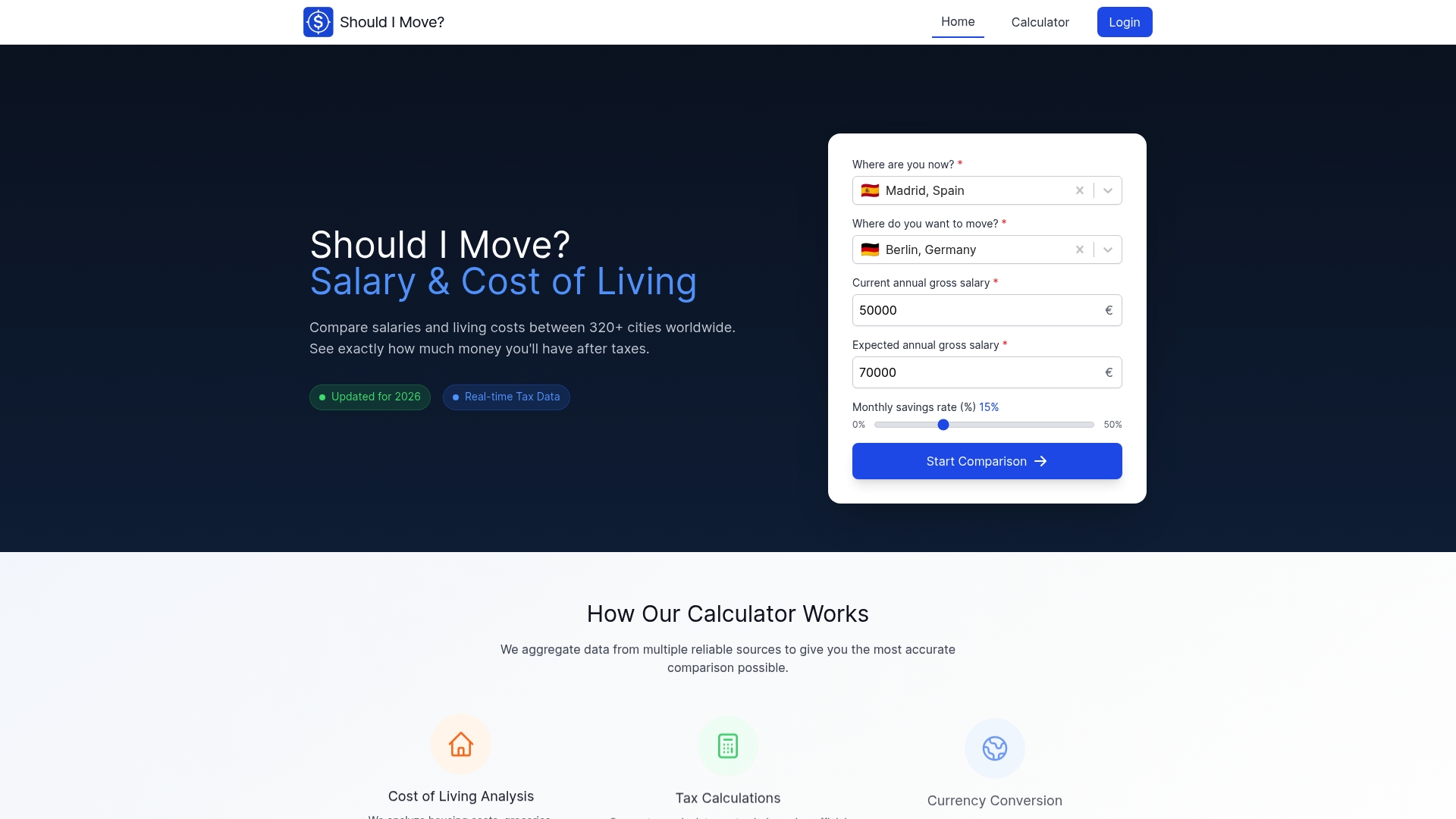
Understanding your take-home pay is the foundation of any relocation decision. ShouldIMove.co runs these calculations for 320+ cities across 35+ countries — enter your gross salary and see your net pay alongside local living costs for a complete financial picture.
Frequently Asked Questions
How do I know which country will tax my income?
Your tax residency determines this. Most countries consider you a tax resident if you spend 183+ days per year there, but some use other criteria like permanent home or center of vital interests. Check the specific rules for your destination country and whether a double taxation treaty with your home country applies.
What is the difference between marginal and effective tax rate?
The marginal rate is the tax percentage on your last dollar of income (the highest bracket you reach). The effective rate is your total tax divided by total income — it is always lower because lower brackets are taxed at lower rates. For financial planning, your effective rate is what matters.
Should I factor in social security contributions when comparing salaries?
Yes. In countries like Germany and France, social security contributions (20%+) can be as large as income tax itself. Ignoring them would make you think your take-home pay is much higher than it actually is.
Are there ways to legally reduce my tax burden as an expat?
Several countries offer special tax regimes for expats — the Dutch 30% ruling, Italy's returning workers scheme, and Portugal's NHR program are well-known examples. You may also benefit from double taxation treaties, foreign tax credits, or the US Foreign Earned Income Exclusion. Consult an international tax specialist for your specific situation.