
A $90,000 salary feels very different in Zurich than it does in Lisbon. After taxes, the Zurich worker takes home roughly $68,000 — but a one-bedroom apartment in the city center costs $2,400/month. In Lisbon, the same gross salary nets about $58,000, yet rent for a comparable apartment runs $1,100/month. The Lisbon worker ends up with more money left over each month despite a lower net salary.
That gap is what cost of living actually measures: how far your income stretches once you pay for housing, food, transport, utilities, and everything else. For remote workers and expats comparing cities, understanding cost of living data — and its limitations — is the difference between a smart move and a financial surprise.
Table of Contents
- What Cost of Living Actually Means
- The Main Expense Categories
- How Cost of Living Indexes Work
- Different Index Types and What They Measure
- Why City-Level Comparisons Matter More Than Country Averages
- Net Salary and Purchasing Power
- Common Misconceptions That Lead to Bad Decisions
Key Takeaways
| Point | Details |
|---|---|
| Cost of living is not just rent | Housing, groceries, transport, utilities, healthcare, and entertainment all factor in. Rent is typically 30-40% of total living costs. |
| Indexes have real limitations | CPI tracks price changes over time, not absolute cost levels. Numbeo compares cities but relies on crowdsourced data with variable accuracy. |
| City-level data matters | Country averages hide massive variation. Munich costs 40-60% more than Berlin for housing despite both being in Germany. |
| Net salary + cost of living = real picture | A high salary in an expensive city can leave you with less disposable income than a moderate salary in an affordable one. |
What Cost of Living Actually Means
Cost of living measures how much money you need to maintain a specific standard of living in a given location. It covers all recurring expenses: housing, food, transportation, utilities, healthcare, and personal spending.
What it does not measure:
- One-time relocation costs (flights, deposits, visa fees) — for a breakdown of these upfront expenses across 10 destinations, see our guide to the real cost of moving abroad
- Quality of life factors (weather, safety, culture)
- Tax burden (which is separate from living costs but equally important)
The IMF has noted that traditional cost of living metrics often undercount the real financial pressure people feel, particularly around housing costs and borrowing. This is worth keeping in mind when reviewing any index — they are useful approximations, not exact mirrors of your personal expenses.
The key insight for relocators: Cost of living is always relative. A city is not "expensive" or "cheap" in absolute terms — it is expensive or cheap relative to your income. That is why comparing cost of living without also comparing net salary gives you an incomplete picture.
The Main Expense Categories
When comparing cities, these are the categories that account for most of the variation:
Housing (typically 30-40% of spending) This is usually the biggest variable. A one-bedroom apartment in the center of Amsterdam runs about $1,600/month. The same type of apartment in Budapest costs around $600. That $1,000/month difference alone accounts for $12,000/year in living cost gap.
Food and Groceries (15-20%) Grocery costs vary less dramatically than rent but still add up. A monthly grocery budget for one person ranges from roughly $200 in Sofia to $450 in Oslo.
Transportation (5-15%) Monthly transit passes range from $20-30 in many Eastern European cities to $90-100 in London or Zurich. Car ownership adds insurance, fuel, and parking costs that vary widely.
Utilities (5-10%) Electricity, heating, water, and internet. Northern European cities tend to have higher heating costs. Internet is relatively uniform across Europe at $25-50/month.
Healthcare (variable) In countries with public healthcare (most of Europe), this may be covered through taxes and social contributions. In others, private insurance is necessary and costs vary significantly.

Here is how monthly expenses compare across three city tiers:
| Category | Expensive City (Zurich) | Mid-Range (Barcelona) | Affordable (Bucharest) |
|---|---|---|---|
| 1-bed rent (center) | $2,400 | $1,100 | $550 |
| Groceries | $450 | $300 | $200 |
| Transport pass | $95 | $55 | $25 |
| Utilities | $200 | $130 | $90 |
| Internet | $50 | $35 | $15 |
| Total basic costs | $3,195 | $1,620 | $880 |
These numbers are approximate and based on aggregated data — your actual spending depends on your habits, neighborhood, and lifestyle.
How Cost of Living Indexes Work
A cost of living index compares the relative expense of living in one place versus another, usually expressed as a number relative to a baseline (often 100 = New York City or a national average).
The basic methodology:
- Define a basket of goods and services — standard items like rent, groceries, restaurant meals, transport
- Collect prices across locations — either through official surveys or crowdsourced submissions
- Weight each category — housing gets more weight than entertainment because it accounts for a larger share of spending
- Calculate a composite score — the weighted average becomes the index number
The Bureau of Labor Statistics explains that the Consumer Price Index (CPI) specifically tracks how prices change over time for a fixed basket of goods. This is important: CPI measures inflation, not absolute cost levels. A city can have low CPI growth (prices are stable) while still being very expensive in absolute terms.
For relocation decisions, you want tools that compare absolute price levels between cities — not just how fast prices are changing.
Different Index Types and What They Measure
Not all indexes serve the same purpose. Here are the ones you will encounter most often:
| Index | What It Measures | Useful For | Key Limitation |
|---|---|---|---|
| Consumer Price Index (CPI) | Price changes over time for a standard basket | Tracking inflation trends | Does not compare absolute costs between cities |
| Purchasing Power Parity (PPP) | How much local currency buys relative to a reference | International salary comparisons | May ignore local tax and expense gaps |
| Numbeo Cost of Living Index | Crowdsourced price comparison between cities | Quick city-to-city comparisons | Data quality varies by city; user-submitted |
| Regional Cost Adjustments | Geographic variations within a country | Domestic relocation decisions | Data granularity varies by region |
Which should you use? For international relocation decisions, Numbeo-style city comparisons give the most directly useful data. PPP is valuable for understanding currency differences. CPI is useful for tracking whether your destination is getting more expensive over time, but less useful for initial city comparison.
The most effective approach is to cross-reference multiple sources. No single index captures your personal financial reality — they all model an "average" consumer who may not match your spending patterns.
Why City-Level Comparisons Matter More Than Country Averages
Country-level data hides enormous variation. Germany is a good example:
- Munich: average rent for a 1-bed apartment in the center is roughly $1,800/month
- Berlin: roughly $1,100/month for the same
- Leipzig: roughly $550/month
All three are in Germany. All three have the same tax system. But the cost of living difference between Munich and Leipzig is larger than the difference between some entire countries.
The same pattern holds across Europe. Living in Milan is significantly more expensive than living in Bologna. Barcelona costs more than Valencia. London costs more than Manchester — and the gap is larger than you might expect.
For remote workers, this creates an opportunity. If your employer pays the same salary regardless of where you live within a country, choosing a less expensive city within that country can dramatically increase your disposable income without any salary negotiation at all.
Net Salary and Purchasing Power
Cost of living data only becomes actionable when you pair it with net salary data. Here is an example:
Two remote workers with the same $75,000 gross salary:
| Factor | Worker A (San Francisco) | Worker B (Lisbon) |
|---|---|---|
| Gross salary | $75,000 | $75,000 |
| Net salary (after tax) | $56,000 | $51,000 |
| Annual basic living costs | $42,000 | $19,500 |
| Disposable income | $14,000 | $31,500 |
Worker B has more than double the disposable income despite a lower net salary. This is the kind of insight that cost of living data provides when combined with tax calculations.
Regional price research confirms that purchasing power — what your money actually buys — varies dramatically even within a single country. The same principle applies globally, with even larger gaps.
The practical takeaway: When evaluating a job offer or a potential relocation, calculate your expected disposable income (net salary minus estimated living costs), not just the gross or net salary. That is the number that determines your actual quality of life.
Common Misconceptions That Lead to Bad Decisions
"This city is cheap" — Cheap compared to what? Prague is cheap compared to Zurich, but expensive compared to where it was five years ago. Always compare against your current situation, not an abstract sense of "cheap."
"The cost of living index says it is 30% cheaper" — Indexes reflect averages. If you spend more on dining out than the average person, or less on rent because you share an apartment, the index number does not apply to you directly. Use it as a starting point, then calculate your personal expenses.
"I checked the CPI and it is low" — Low CPI means prices are not rising fast. It does not mean the city is affordable. Tokyo has had low inflation for decades but remains one of the most expensive cities in the world.
"Country X is cheaper than Country Y" — Maybe on average. But Tallinn (Estonia) can be more expensive than some Spanish cities despite Estonia being "cheaper" as a country. Always compare at the city level.
"I will save money by moving to a cheaper country" — Only if your income stays the same or decreases less than your costs. If you take a local salary in a "cheap" country, your disposable income might not improve at all.
Compare Net Salary and Living Costs Before You Move
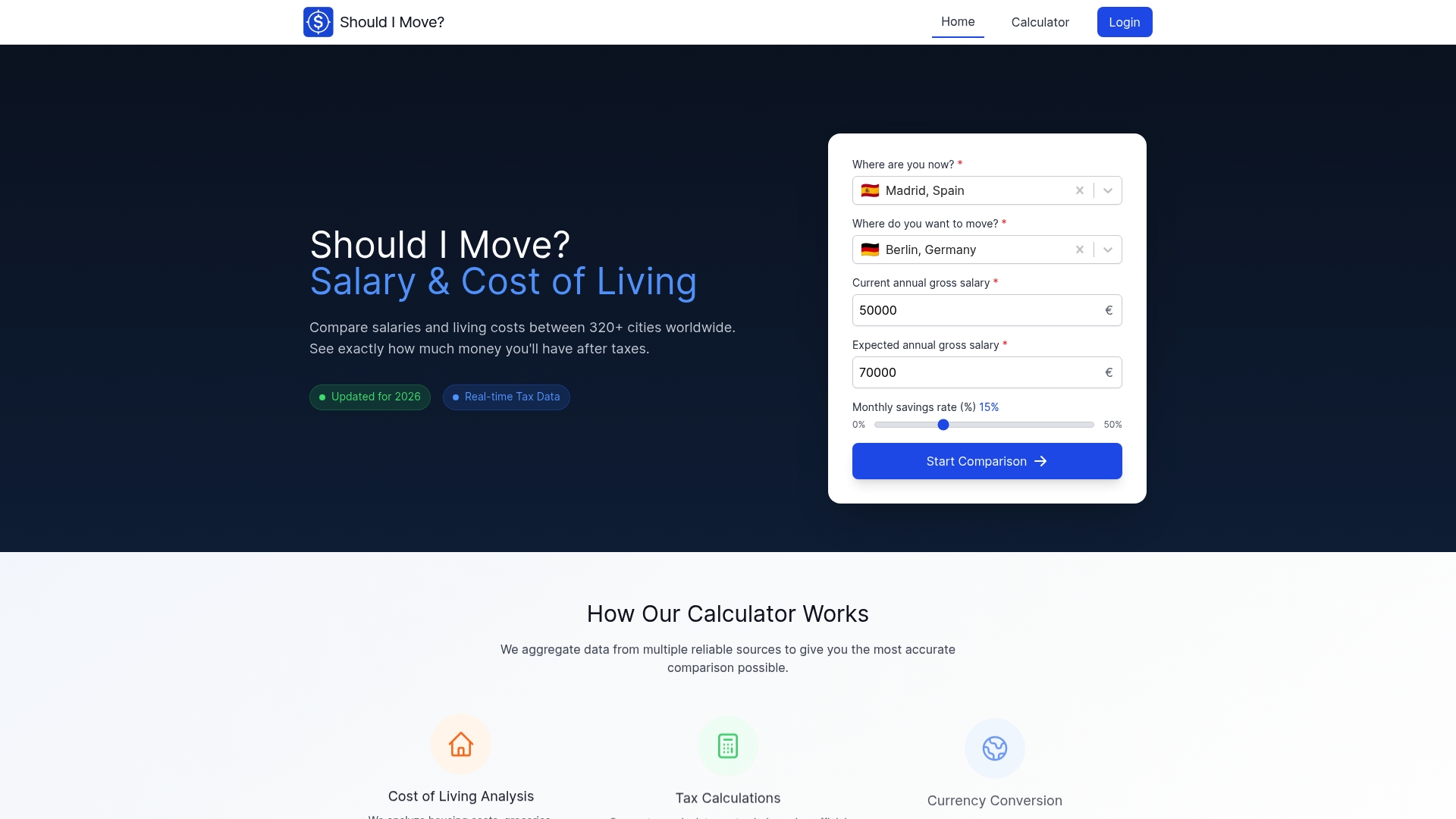
Cost of living data is most useful when paired with tax and salary data for a complete financial picture. ShouldIMove.co combines both — enter your gross salary, pick two cities, and see the difference in take-home pay and monthly expenses side by side.
Frequently Asked Questions
What is the most reliable source for cost of living data?
No single source is definitive. Numbeo has the largest crowdsourced database for city comparisons. Official government statistics (like the BLS or Eurostat) are more rigorous but slower to update and often only available at the country level. Cross-reference at least two sources before making decisions.
How accurate are cost of living indexes for personal planning?
They are useful directional indicators but not personal budgets. Indexes model an average consumer — if your spending patterns differ (e.g., you cook at home instead of eating out, or you need a larger apartment for a family), the index number will not match your experience. Use indexes for initial comparison, then build a personal expense estimate.
Should I compare cost of living at the country or city level?
City level, always. Country averages mask enormous variation. The difference between the most and least expensive cities within a single country can be larger than the difference between country averages of different nations.
How do cost of living and net salary interact for relocation decisions?
A city with a higher salary but proportionally higher costs may leave you with less disposable income than a lower-salary city with much lower costs. The key metric is disposable income: net salary minus estimated monthly expenses. That is what determines your financial comfort after a move.